June 18, 2007

Real drama

What a finish! I watched the Primera Liga's final match between Real Madrid and Real Mallorca live on RealMadrid TV which started at about 2 a.m. And it was unlike any other football game I've watched so far. It was similar to how I felt when the Bulls trailed the Suns in the 1993 NBA Finals and against the Jazz in 1998.

To give you an idea, Real Madrid had to win that match to win the league title and end their 4-year trophy drought. In the Spanish Primera Liga, the champions will be the club with the most points at the end of the season. Heading into the final day, Real Madrid and arch-rivals Barcelona were tied with 73 points. By virtue of a better head-to-head record (Madrid defeated Barcelona at the Bernabeu 2-0, and drawn 3-3 at the Nou Camp), Real Madrid would be champions if they remained tied (in terms of points). For those who are not familiar with the scoring, a win is worth 3 points, a draw 1 point, and no point for a loss.

The race itself was extremely tight the final weeks, and Real Madrid had a series of amazing comebacks and good fortune in their past games.

On May 12 against Espanyol, they came back from a 3-1 halftime deficit to win 4-3.

On May 20 against Recreativo Huelva, Roberto Carlos scored in the dying minutes of injury time and gave Real Madrid a 3-2 win. The Brazilian left-back raced down the full pitch, settled Fernando Gago's cross and scored under the sliding goalkeeper. The win gave Madrid 69 points, the same as Barcelona, with 3 more matches left.

On May 26, they won against Deportivo, keeping them tied with Barca with 72 points.

On the penultimate match day on June 29, both Real Madrid and Barca were playing at the same time. With a couple of minutes left on both matches, Barca were leading Espanyol 2-1 while Madrid were losing to Zaragoza 1-2. It was then when Madrid's top striker Ruud Van Nistelrooy scored a goal a minute from the final whistle to tie the match at 2-2. In amazing stroke of good fortune, seconds later, Espanyol's Raul Tamudo scored a late equalizer with 25 seconds left. So the day ended with Madrid and Barca both with 73 points.

Thus, the league championship depended on the last game.

For over an hour the title looked to have slipped from Real's grasp as they trailed to a 17th-minute strike from Mallorca's Fernando Varela, while Barca overpowered Gimnastic.

Real suffered another setback when league leading goal scorer van Nistelrooy was forced off in the 32nd minute after appearing to pull a hamstring as he ran towards goal. At halftime, Mallorca led 1-0. Barcelona, meanwhile, went 3-0 up by the break with goals from Messi and Ronaldinho.

Real manager Fabio Capello introduced the inconsistent Guti at the start of the second half but his side continued to live dangerously with a succession of last-ditch tackles stopping Mallorca adding to their lead.

It became worse midway through the second half, as David Beckham, the man who is largely responsible for Real's resurgence the past couple of months, limped off the pitch and was substituted by Jose Antonio Reyes.

Little did everyone know that the substitute would become Real's hero, equalizing a minute after coming on in the second half. Reyes fired in from close range after some dazzling footwork by Robinho and Gonzalo Higuain on the right side of the area.

The Bernabeu burst into life after Reyes's goal and Real were back on top of the table 12 minutes later when Diarra, called back from international duty with Mali, sent a header bouncing off Mallorca's Angelos Basinas and across the line. The Bernabeu crowd (who interestingly included a Beckham party consisting of wife Posh spice and Hollywood couple Tom Cruise and Katie Holmes) was ecstatic. Again, it was unlike anything I have ever witnessed. The Madrid fans were partying.

Reyes made sure of victory four minutes later with a great strike from the edge of the area to spark wild celebrations.

As the final whistle sounded, the Bernabeu went wild. Fireworks were lit, and an amazing celebration and ceremony was held. After this, the team paraded throughout the city of Madrid on their team bus with tens of thousands of frenzied fans surrounding them.

I watched all of these on TV from 2am to around 8am. Really incredible nail-biting drama.

This record 30th league championship saved Real Madrid's otherwise disappointing season. After a major overhaul in the off-season (hiring a new coach and signing the likes of Cannavaro, van Nistelrooy, and Diarra), the team was full of potential. However, for some reason, the team struggled early and got eliminated early in the European Champions League and the Spanish King's Cup. It also signified the end of the Madrid careers of Brazilian superstar Roberto Carlos and English football icon David Beckham. The important thing was that Real Madrid was hopefully back on their winning ways, ending a four-year drought. Hopefully, things will even be better next year.

Labels: , , ,

August 24, 2006

Real Excitement

The Spanish Football League, the Primera Liga, had just begun its 2006-2007 season. As expected, I had been up to date with all the off-season transfers and other transactions by the clubs, especially those by Real Madrid, the team I have been following the past years.

The past three seasons have been very disappointing. Recently, Real Madrid was named the “Best Football Club of the Century” by FIFA. However, they haven’t won anything big in the last three seasons, in spite having superstars like Zidane, Ronaldo, Beckham, Owen, Figo, and Raul in their roster. Many good things did happen the past few months, hoping to change the losing trend.

The first thing was the stepping down of Florentino Perez as club president. Perez initially did a good job in building the team, with the signing of Figo, Zidane, and Ronaldo. However, it would seem that he was more contented in “selling” the team rather than winning. I believe he was more concerned with ticket and jersey sales. His belief was that the more superstars, the better the team would be. Not to take anything away from his achievements, but to be honest, the team was underperforming. They were more like a group of superstars and they never jelled as a team. People were there not to watch the team play, but simply to get a glimpse of the individual superstars.

Ramon Calderon is now the club’s president and the first thing he did was to bring in Fabio Capello as manager (coach). Capello is a known disciplinarian. He’s very precise and somewhat of a perfectionist. I liken him to Pat Riley of the NBA. Capello won wherever he had coached. Coming from Italian champs Juventus (who were stripped off their titles because of the match-fixing scandal), he also won at Roma and interestingly Real Madrid a decade ago. To me, he is perfect for the club because the players seem to be undisciplined. Capello likes players who work and train hard and he rewards them by letting them play on the pitch. Unlike the previous managers, there is no superstar treatment under Capello.

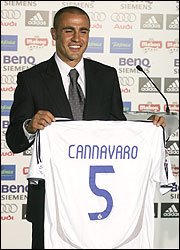
Fabio Capello believes in the importance of a strong defense, and proof to that is the acquisition of Italy’s World Cup-winning captain (and tournament’s best defender) Fabio Cannavaro and the Brazilian defensive midfielder Emerson from Capello’s previous club, Juventus. I like these two signings. I believe that the weakest aspect of Real Madrid was their defense. Ever since central defender Fernando Hierro and defensive midfielder Claude Makelele left the team three years ago, Real Madrid always had problems in defense. Hopeful, the seasoned veterans Cannavaro and Emerson would fill their shoes well.

Another advantage of these two signings was the fact that they already have the experience playing for Capello, and I see the two as the extensions of the manager on the pitch. Without a doubt, the other players would adjust better to Capello because of the assistance of Cannavaro and Emerson not only during games, but more importantly, during training.


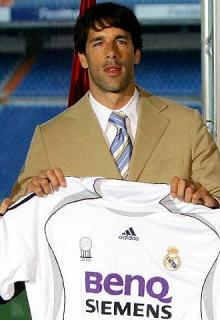
Real Madrid also got forward Ruud Van Nistelrooy from Manchester United. I am not a big fan of this Dutch striker, but I have to admit he is a proven goal scorer. However, I do not think he is that needed since Real Madrid already has 3-time World Player of the Year Ronaldo as their main striker. The good thing is that he brings another aspect to the club. The Brazilian Ronaldo is more creative and can score on his own. Van Nistelrooy is more opportunistic, similar to Raul, another forward already on the club. I am afraid that one of these strikers would be similar to Michael Owen a few years ago. Owen was a world class striker but he had to come off the bench behind the likes of Ronaldo and Raul. Nevertheless, if somehow Capello manages to play Ronaldo, Raul, and Van Nistelrooy in a balanced rotation, then it will all work best for Real Madrid.

The next move was the signing of Mali defensive midfielder Mahamadou Diarra from French club Olympique Lyon. He would combine with Emerson to form what Real Madrid hopes would be a water-tight midfield. They would certainly win more possessions from the midfield for the club. I like this acquisition too. Some say Diarra and Emerson are too similar, but I believe Diarra can also attack and can move a bit forward.

Because of the arrival of Diarra and Emerson, there seemed to be an excess of defensive midfielders. Hence, Danish Tomas Graveson and Uruguayan Pablo Garcia were released to other clubs. Another Uruguay international, Carlos Diogo, a right-back was also loaned to another club since he was third in line behind more preferred right-backs Spanish Michel Salgado and Brazilian Cicinho.

There was also an excess of central defenders and so Real Madrid released English Jonathan Woodgate on loan for a year. Personally, I believe Woodgate shouldn’t have been released. He could be an excellent backup to Cannavaro and Ramos. I honestly don’t understand this move.

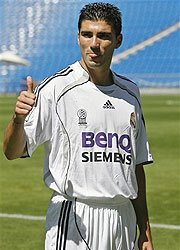
A better move was the swap deal between Real Madrid and English club Arsenal. The 1-year agreement sends Brazilian striker/midfielder Julio Baptista to Arsenal on loan while midfielder Jose Antonio Reyes goes home to his country also on loan. Reyes brings speed and youth to Real Madrid, similar to Robinho. Hopefully the two would combine well to outrun and outbreak opposing clubs on the pitch.

Aside from the lack of backup central defenders, my other worry is who would be the link between the defense and attack. It seems that Real Madrid already has a strong defense and an excellent attacking line. But the missing link seems to be in the midfield, the role that Zinedine Zidane used to play before he retired. Who would be the distributor or the playmaker? That was why I was hoping Real Madrid would have picked up someone like Kaka. Anyway, it seems like the only possible player who could fill that spot is Guti. He could be the playmaker but he is nowhere near the level of a Zidane or even a Kaka.

Another possible problem is how Cappello rotates his superstars. I could not think of a starting 11 because of the many options available. Since Cappello already has fixed a back line composing of 2 holding midfielders (Emerson and Diarra) and 4 defenders plus the goalkeeper, it would appear that Real Madrid have a lot of players for the remaining 4 spots. That means selecting the 4 in attack from Ronaldo, Raul, Van Nistelrooy, Cassano, Robinho, Beckham, Reyes, and Guti. Tough decision there.

Overall though, I look forward to the team. I think good things will happen this season, and I am pretty sure they would have success in at least one of the three competitions they will be participating in – the Primera Liga, Champions League, and the Copa del Rey. This is certainly a very much improved Real Madrid. Look out Barcelona!

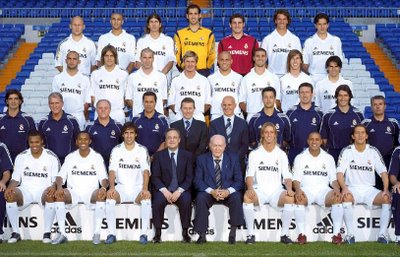
This is the current first team line up with their jersey numbers:

1 – Iker Casillas (Spain) – GK
2 – Michel Salgado (Spain) – Def
3 – Roberto Carlos (Brazil) – Def
4 – Sergio Ramos (Spain) – Def
5 – Fabio Cannavaro (Italy) – Def
6 – Mahamadou Diarra (Mali) – Mid
7 – Raul Gonzales (Spain) – For
8 – Emerson (Brazil) – Mid
9 – Ronaldo (Brazil) – For
10 – Robinho (Brazil) – For
11 – Cicinho (Brazil) – Def
13 – Diego Lopez – GK
14 – Guti (Spain) – Mid
15 – Raul Bravo (Spain) – Def
17 – Ruud Van Nistelrooy (Netherlands) – For
18 – Antonio Cassano (Italy) – For
19 – Jose Antonio Reyes (Spain) – For
21 – Ivan Helguerra (Spain) – Def
22 – Paco Pavon (Spain) – Def
23 – David Beckham (England) – Mid
24 – Alvaro Mejia (Spain) – Def

Try picking your starting 11.

Labels: , , , , ,

March 09, 2006

Too many stars...

For the 3rd straight year, legendary Spanish football (soccer) club Real Madrid will not be taking home any major championship trophy, after their early exit in the UEFA Champions League. I woke up at 3 this morning just to watch them draw the 2nd leg of their last-16 match against English team Arsenal 0-0. Real Madrid lost on a 1-0 aggregate score since Arsenal won the 1st leg played at Madrid two weeks ago 1-0 on a brilliant goal by captain Thierry Henry. Although it was a goal-less game, it was nonetheless exciting till the end. I was of course rooting for Real, and they had lots of chances, including two near-misses by captain Raul. I also thought Ronaldo should have been awarded a penalty in the first half after being tackled from behind by Roberto.

This only proves one thing. The better team would always emerge victors. Sure, on paper Real Madrid would seem much better, with the likes of superstars Ronaldo, Zidane, Beckham, and Raul in their squad. The club, led by president Florentino Pérez, who had recently resigned, has made a habit of buying at least one galáctico (superstar) every year. (A Galáctico is a term used to describe a world-famous soccer player who transfers to Real Madrid). To show you how much star-power its lineup has, over the past 6 years under Pérez's helm, these are some of the players acquired by the club:

2000 - Luis Figo (2001 World Player of the Year)
2001 - Zinedine Zidane (1998, 2000, 2003 World Player of the Year)
2002 - Ronaldo (1996, 1997, 2002 World Player of the Year)
2003 - David Beckham(2-time runner-up, World Player of the Year)
2004 - Michael Owen (2001 European Player of the Year)
2005 - Robinho (heralded as the next Pelé), Julio Baptista

Although this policy has certainly helped cement Real's status as perhaps the world's most prestigious and most popular club, it has so far had limited success on the pitch. If it's based on star quality, Real would certainly be the best team in the world. However, in the world of team sports, that's not always the case.

Recall a couple of years ago when the underdogs Detroit Pistons dominated the star-studded Los Angeles Lakers in the 2004 NBA Finals. The Lakers were a team of superstars - Shaquille O'neal, Kobe Bryant, Karl Malone, and Gary Payton. They were also guided by a "superstar" coach in the name of Phil Jackson, a man with 9 NBA championship rings. One more would have made it a ring for every finger.
On the other hand, the Pistons did not even have one who could be considered a superstar. Sure, they had good players like the Wallaces (Ben and Rasheed) as well as Chauncey Billups and Rip Hamilton, but none of them were big-names. What they had though was dedication to play as a team on both ends of the floor. They did not care who scored the most points or who got the biggest attention. They were clearly the better team on the court. And they surprised the Lakers and everyone else except me (I knew they were gonna win it all even before the playoffs) by winning the title in a modern day David versus Goliath story.


Another example would be the United States' basketball Dream Team, a team composed of NBA superstars. Of course, it was not like the original Dream Team that ran away with the Olympic gold medal in the 1992 Barcelona games. The players on that team, led by Michael Jordan, Magic Johnson, and Larry Bird, were all superstars but they also knew how to play as a team. Perhaps, that would remain the greatest team ever assembled in the history of sports.
The most recent USA team, however, placed a very disappointing 6th in the 2002 World Championship and 3rd in the 2004 Olympics. How can a team led by Tim Duncan, Allen Iverson, LeBron James, Dwyane Wade and a whole bunch of other superstars lose? You may say that the rest of the world is catching up with the United States, but the bigger reason is that you can't simply toss in the best players and assume that they'd become the best team too. You have to consider the chemistry and balance, and how they play as a unit.

Team USA has began its preparation for the 2008 Olympics in Beijing. All players, regardless of their star status will have to do something new to most NBA stars: tryout for the team. Team USA director Jerry Colangelo announced the list of 23 players who will try out for the team in July. Colangelo and coach Mike Krzyzewski will pick a 15-man roster (with 12 active players). Interestingly, 2004 USA co-captain Allen Iverson was not invited.

Unlike the previous Dream Teams, the roster will not be composed of the biggest names available. They would have more role players like Bruce Bowen, Luke Ridnour, and Shane Battier, who were all invited to the tryouts.
The bottom line is that these are team sports. The better team should win. It's not the name at the back of the jersey that matters, but it's the one at the front that's important.

Labels: , , , , , , , , , ,